Showing posts with label General Knowledge. Show all posts

Thursday, February 12, 2009

Me as Obama

Economy

“Many Americans have lost their jobs. Because of this, they don’t have enough funds to buy foods. This will surely lead to hunger. Mr. President, what do you think will happen on our economy this year? Will it go back to normal and stabilize or will it worsen?”

The truth is, most Americans aren't asking for a lot. They don't need overseas tax shelters; they don't need a long list of loopholes. All they want is a fair shake, and they could stand a break because most Americans have simple dreams: a job, a place to raise their families, a secure retirement, and a chance to create opportunities for their kids that might extend a little further than their own. After all, the wealth of the nation is rooted in the work of our people.” I am warning the Americans now because our economic crisis will deepen this year. I already revealed some details of a massive stimulus package that could ultimately exceed in $1 trillion. We, as Americans, will face this economic crisis. I will call for a cabinet meeting tomorrow to discuss this growing crisis which affects the whole world. We already lost 1.2 million jobs inside the country. Millions of American families are struggling to figure out how to pay the bills and stay in their home. This is very alarming. This will result to a deeper problem. I and my cabinet is planning to launch a project to help these people who lost their jobs. Sec. Solis and Sec. Geithner, prepare some plans for this problem and we’ll be discussing it tomorrow. I promise this cabinet meeting will be transparent to everyone.

Me as Obama

On Iraq

“There are some rumors that you are planning to add more American troops on the Middle East. How true is this?”

"I stand before you as someone who is not opposed to war in all circumstances. The Civil War was one of the bloodiest in history, and yet it was only through the crucible of the sword, the sacrifice of multitudes, that we could begin to perfect this union and drive the scourge of slavery from our soil.” As I have told you in my electoral campaign, I said that I will pull out ALL of our American soldiers in the Middle East to promote peace not only between America and Iraq, but between all nations. I already asked my security adviser, Retired Marine Gen. James Jones, to prepare plans in pulling out our troops in 16 months with the help of Secretary Robert Gates, our secretary of defense. The rumor is a false rumor.

Me as Obama

Financial System

“The US of A is having a great economic recession. People are loosing their jobs. For sure, some of these people would like to help on this problem for them able to gain back their jobs. How would we, the people, help restore our good financial system?”

“In order to restore our financial system, we’ve got to restore trust. And in order to restore trust, we’ve got to make certain that taxpayer funds are not subsidizing excessive compensation packages on Wall Street. We all need to take responsibility. And this includes executives at major financial firms who turned to the American people, hat in hand, when they were in trouble, even as they paid themselves their customary lavish bonuses. As I said last week, that’s the height of irresponsibility. That’s shameful. And that’s exactly the kind of disregard for the costs and consequences of their actions that brought about this crisis: a culture of narrow self-interest and short-term gain at the expense of everything else."

Sunday, November 2, 2008

Cosme - Ang Bagyo

Severe Tropical Storm Halong (Cosme - PAGASA) was the fourth severe tropical storm named by the Japan Meteorological Agency (JMA) who are the Regional Specialized Meteorological Centre for the north western Pacific Ocean. The Joint Typhoon Warning Center also recognized Halong as the fifth tropical depression, the fourth tropical storm as well as the third typhoon of the 2008 Pacific typhoon season.


The name "Halong" was one of the 10 original names submitted by Vietnam to the WMO's Typhoon Committee for use from January 1, 2000. Halong was last used in the 2002 Pacific typhoon season and is named after Halong Bay, which is a UNESCO World Heritage site in Vietnam. The Philippine Atmospheric, Geophysical and Astronomical Services Administration (PAGASA) assigned the name Cosme to the tropical storm. Cosme was last used in the 2004 Pacific typhoon season to name Sudal.

Meteorological History
Late on May 13 a tropical disturbance formed in the South China Sea. Early the next day the Japan Meteorological Agency (JMA) & The Philippine Atmospheric, Geophysical and Astronomical Services Administration (PAGASA), designated the disturbance as a tropical depression, with PAGASA designating it as tropical depression Cosme. However the Joint Typhoon Warning Center (JTWC) did not issue a Tropical Cyclone Formation Alert until later that day. The JTWC then designated the depression as 05W on May 15. On May 16 both the JMA and the JTWC upgraded the depression to a tropical storm with the JMA designating it as Tropical Storm Halong and assigning the international number of 0804. This was 12 hours after PAGASA had upgraded it to a tropical storm. During that day Halong kept intensifying and was designated as a severe tropical storm early the next day by the JMA as it reached its peak wind speeds of 60 knots (70 mph 115 km/h). The JTWC then upgraded Halong to a typhoon with peak wind speeds of 70 knots (80 mph 130 km/h) which made Halong a Category one typhoon on the Saffir-Simpson Hurricane Scale.

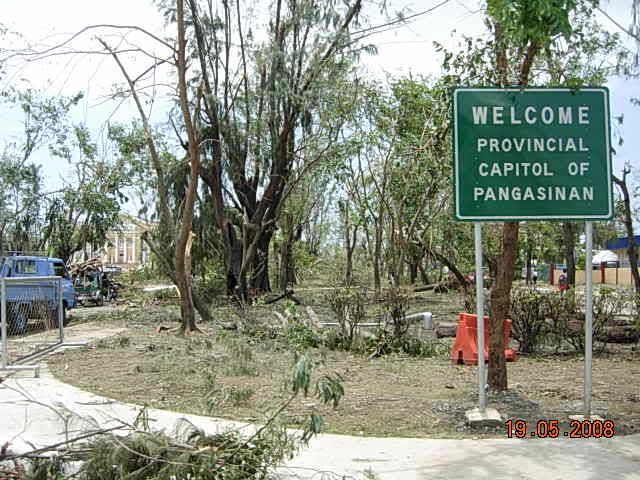
Later on May 17 Halong made landfall on the Philippine region of Pangasinan and traveled towards the northeast over Luzon. Whilst over land Halong weakened in to a tropical storm with both the JTWC and the JMA downgrading Halong early the next day. Later that day after reaching the Philippine Sea, Halong started to re strengthen and intensified in to a severe tropical storm. However it did not intensify any further and on May 19 weakened in to a tropical storm. Later on May 19 PAGASA issued their final advisory on Halong as it moved out of their area of responsibility. The JTWC then issued their last advisory on Halong as it had began its extra tropical transition the JMA then reported that it had completed its extra tropical transition and issued their final advisory on the remnant low of Halong. The remnants of Halong dissipated on May 24.

Preparations

Starting May 15, PAGASA issued Storm Warning Signals for various areas across the Philippines. At 1500 UTC that day Signal Number One was initially issued over northern Palawan, Occidental Mindoro and Lubang Island. At its maximum coverage (at 0930 UTC 17 May), Storm Signal Number 3 was issued for Zambales, Pangasinan, La Union, Tarlac, Benguet and Ilocos Sur, Signal Number 2 was for Bataan, Bulacan, Pampanga, Nueva Viscaya, Nueva Ecija, Quirino, Ifugao, Mt. Province, Kalinga, Abra, Apayao and Ilocos Norte and Signal Number 1 was raised for Lubang Island, Batangas, Cavite, Laguna, Rizal, northern Quezon, Isabela, Aurora, Cagayan, Calayan Island, Babuyan Group of Islands, Batanes and Metro Manila Further on as Cosme (Halong) razed through Northern Luzon, these storm signals were scaled back until the storm reached the Cagayan-Batanes area and the Pacific Ocean proper.

Impact
In Luzon, the Typhoon caused 58 deaths and $94 million (USD) in damage. The storm destroyed 43,365 houses and damaged 188,830 more. Most of the damages reported were in Northern Luzon. Meanwhile, Mindoro and Panay islands were also affected as the storm-induced southwest monsoon brought rains and floods to those areas. In particular, a ferry in Mindoro was stranded as Cosme (still a tropical depression that time) passed close enough to Mindoro Thursday night (May 15). The Subic-Olongapo area, one of the economic zones of the Philippines, experienced power outages as the storm gets closer to Zambales on May 17. The province of Pangasinan, where the storm made its landfall, experienced waist-high floods and power outages as well. Even the city of Dagupan (in Pangasinan) suffered the same fate with even stranded persons all over the city due to flooding. The town of Sta. Cruz in Zambales had about 7,000 people homeless due to Cosme. Overall, the hardest hit were Pangasinan and Zambales provinces. Because the damage caused by the storm in Zambales is extensive even in infrastructure, repair was forced to be done on schools there as that time, classes are to resume in the next few weeks. The storm also increased the prices of vegetables in Metro Manila, as the latter gets most of its vegetables from Northern Luzon.

According to the final report on Cosme (Halong) released by the National Disaster Coordinating Council, 61 were reported killed, 33 wounded and three were left missing. People affected by Cosme numbered 1,496,635 persons in 1,510 barangays in five provinces. Damages to property totaled to PHP 4.712 billion, of PHP 3.721 billion were agricultural losses and PHP 992 million were destructed infrastructure. Pangasinan was the most damaged province as indicated by the report.

Saturday, October 25, 2008

L'art Du Déplacement

Parkour (sometimes abbreviated to PK) or l'art du déplacement (English: the art of movement) is an activity with the aim of moving from one point to another as efficiently and quickly as possible, using principally the abilities of the human body. It is meant to help one overcome obstacles, which can be anything in the surrounding environment—from branches and rocks to rails and concrete walls—and can be practiced in both rural and urban areas. Parkour practitioners are referred to as traceurs, or traceuses for females.

Founded by David Belle in France, parkour focuses on practicing efficient movements to develop one's body and mind to be able to overcome obstacles in an emergency.

Parkour is a physical activity that is difficult to categorize. Often miscategorized as a sport or an extreme sport, parkour has no set of rules, team work, formal hierarchy, or competitiveness. It is an art or discipline that resembles self-defense in the ancient martial arts. According to David Belle, "the physical aspect of parkour is getting over all the obstacles in your path as you would in an emergency. You want to move in such a way, with any movement, as to help you gain the most ground on someone or something, whether escaping from it or chasing toward it." Thus, when faced with a hostile confrontation with a person, one will be able to speak, fight, or flee. As martial arts are a form of training for the fight, parkour is a form of training for the flight. Because of its unique nature, it is often said that parkour is in its own category.

A characteristic of parkour is efficiency. Practitioners move not only as fast as they can, but also in the most direct and efficient way possible; a characteristic that distinguishes it from the similar practice of free running, which places more emphasis on freedom of movement, such as acrobatics. Efficiency also involves avoiding injuries, short and long-term, part of why parkour's unofficial motto is être et durer (to be and to last). Those who are skilled at this activity normally have an extremely keen spatial awareness (a.k.a. air sense).

Traceurs say that parkour also influences one's thought process by enhancing self-confidence and critical-thinking skills that allow one to overcome everyday physical and mental obstacles. A study by Neuropsychiatrie de l'Enfance et de l'Adolescence in France reflects that traceurs seek for more sensation and leadership than gymnastic practitioners.


- Source: Wikipedia - The Free Online Encyclopedia

Brief History of Pangasinan National High School

The name Pangasinan National High School, the Alma Mater of thousands of illustrious men and women, evolved from very colorful educational, political and economic scenarios of the past. Organized in 1908 and supported by the provincial government, it admitted fifth grade to first year students in rented buildings at the heart of Lingayen, the capital town. Being the first provincial school of the biggest province of Luzon, it was initially named Pangasinan High School when increased high school enrollment in the multi-grade classes paved the way to its separation from elementary school in 1920. Then in 1926 through 1927, continuing changes took effect again changing the name to Pangasinan Academic High School for the academically inclined and giving birth to Pangasinan Vocational High School for the vocationally inclined, both as autonomous units.

The recession in 1930 aggravated by frequent typhoons which resulted to poor harvest and consequently lesser enrollments forced the fusion of the Pangasinan Academic High School and the Pangasinan Vocational High School to form the Pangasinan Secondary School, the third name shift in 1935 through 1936.

Forming the first bulk of the teaching force were the recruited Americans from the Occupation Army during the Fil-American War and volunteers who arrived via the USS Thomas. In 1913, thirteen graduates proudly marched in the very first graduation rites.

After the leave of absence in 1938 by Mr. Arthur Allison, the last American principal, (preceded by Messrs. Hare, Heidenrich, Abada, Wullenburg and Blackledge), Mr. Juan C. Manuel followed by Mr. Ricardo Ortega as OIC and Mr. Eufronio Malonzo, 1938 appointed principal, took charge of the school.

In 1940, the Pangasinan Secondary School was reverted into two independent units. Pangasinan High School and the Pangasinan Trade School.

During World War II, Pangasinan High School closed its doors and re-opened in January 1945 and was renamed Pangasinan Provincial High School until 1969 after which became Pangasinan National High School by virtue of a national legislation.

Postwar principal included Messrs. Eduardo Edralin, Angel Fermo and Fermin Montano. Since 1952, women who had been principal were: Miss Carmen dela Cruz (1952-1967); Mrs. Rolendia S. Edralin (1967-1973); Mrs. Adoracion R. Ramos (1974-1984); Miss Beatriz D. Cruz (1984-1988); Mrs. Natividad A. Cruz, OIC (1988-1989); Mrs. Juliana B. Laoag (1989-1995); and Dr. Lolita R. Salomon (1995 to 2004); Mrs. Zenaida T. Cervantes (2004-2006); Dr. Aurora C. Micu (2007 to present).

Thursday, October 9, 2008

Santa Claus, Are You For Reality?


Santa Claus, also known as Saint Nicholas, Father Christmas, Kris Kringle, or simply "Santa", is the ghost of Saint Nicholas who, in Western cultures, is described as bringing gifts on Christmas Eve or Christmas Day, or on his feast day, December 6. The legend may have its basis in hagiographical tales concerning the historical figure of Saint Nicholas.

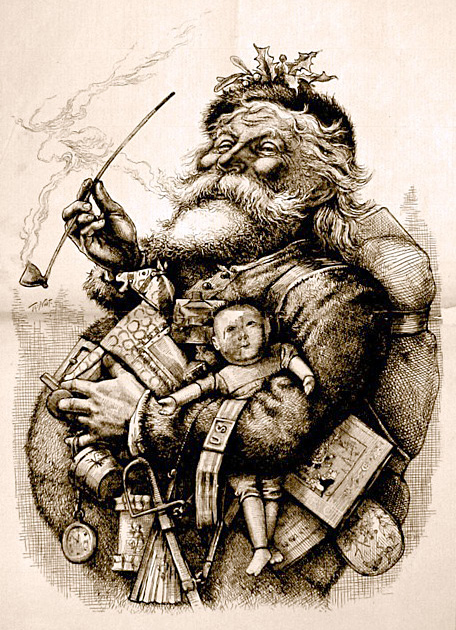
The modern depiction of Santa Claus as a fat, jolly man (or gnome) wearing a red coat and trousers with white cuffs and collar, and black leather belt and boots, became popular in the United States in the 19th century due to the significant influence of caricaturist and political cartoonist Thomas Nast. This image has been maintained and reinforced through song, radio, television, and films. In the United Kingdom and Europe, his depiction is often identical to the American Santa, but he is commonly called Father Christmas.

One legend associated with Santa says that he lives in the far north, in a land of perpetual snow. The American version of Santa Claus lives at the North Pole, while Father Christmas is said to reside in Lapland. Other details include: that he is married and lives with Mrs. Claus; that he makes a list of children throughout the world, categorizing them according to their behavior; that he delivers presents, including toys, candy, and other presents to all of the good boys and girls in the world, and sometimes coal or sticks to the naughty children, in one night; and that he accomplishes this feat with the aid of magical elves who make the toys, and nine flying reindeer who pull his sleigh.

There has long been opposition to teaching children to believe in Santa Claus. Some Christians say the Santa tradition detracts from the religious origins and purpose of Christmas. Other critics feel that Santa Claus is an elaborate lie, and that it is unethical for parents to teach their children to believe in his existence. Still others oppose Santa Claus as a symbol of the commercialization of the Christmas holiday, or as an intrusion upon their own national traditions.