Showing posts with label Information. Show all posts

Wednesday, January 14, 2009

Personal Writing

“Life can be found only in the present moment. The past is gone, the future is not yet here, and if we do not go back to ourselves in the present moment, we cannot be in touch with life.”

I live my life to the fullest. I don’t waste a single moment of it. At present, I think about the past and plan for the future. Well, its not death who fears me, its life itself. I always fear what may happen tomorrow. The challenges I may face and the problems I may encounter. But thanks to God, I always have the courage to go on.

I appreciate the beauty of nature so much. The greenest grass and the bluest sky amaze me. Sometimes, I dream of lying down a meadow watching birds above me fly by. That would be great. But as I see in my environment, some people don’t care for it. They don’t know the real power of Mother Nature.

Life without friends is a complete boredom. I laugh, play, joke and live with them. They make good company with me. I can be a nomad. I can join different circles. But they do match my best friend.

This angel was sent to me by heaven. Though she’s kind of dumb, I can deal with it. I’m a little bit dumb, too. We laugh at ones mistake at once learn from it. We laugh together, sing together, share secrets and experiences together and make memoirs together. We can’t avoid some quarrels, from the shallowest problems like what is the meaning of paranoid to the deepest like the issues about “jealousy” between us. Some think that I’m courting her, well, back off dudes, I’m not.

The end of high school is fast approaching! Friends will be separated. Many of us fear this. Many. I don’t fear this because I know; my best friend will not leave me. I have trust on her. Same here, I will not leave her.

I have passion on working with the camera and computer. My older brother brought me to this. He teaches me the ABCs and I learn by my self the XYZs. My subjects are usually backed-up by the blue sky. Why? I don’t know. Some of my shots are located on the next pages of this compilation.

In the photographs above, I look like my most serious man in the world. I’m not. I just love to emote in front of the lenses. Those pictures were just taken this school year. It shows the real me, somewhat emotional and serious though it doesn’t show that I am also a jolly person. A very happy one. Also, it doesn’t show that I am incomplete because of something. Something which makes my heart cries every night.

This is the deeper Zeus. In my blog, call me Yohann.

Monday, December 22, 2008

Twilight - Novel


Isabella "Bella" Swan moves from sunny Phoenix, Arizona to rainy Forks, Washington to live with her father, Charlie. She chooses to do this so that her mother, Renée, can travel with her new husband, Phil Dwyer, who is a minor league baseball player. Bella attracts much attention at her new school and is quickly befriended by several students. Much to her dismay, several boys in the school compete for shy Bella's attention.

When Bella sits next to Edward Cullen in class on her first day of school, Edward seems utterly repulsed by her. After tricking a family friend, Jacob Black, into telling her local tribal legends, Bella concludes that Edward and his family are vampires who drink the blood of animals, not humans. Edward reveals that he initially avoided Bella because the scent of her blood was so desirable to him. Over time, Edward and Bella fall in love.

Their relationship is thrown into chaos when another vampire coven sweeps into Forks and James, a tracker vampire, decides that he wants to hunt Bella for sport. The Cullens plan to distract the tracker by splitting up Bella and Edward, and Bella is sent to hide in a hotel in Phoenix. Bella then gets a phone call from James in which he says that he has her mother, and that Bella must give herself up to save her. She does so and James attacks her, but Edward, along with the rest of the Cullen family, rescues Bella before James can kill her. Once they realize that James has bitten Bella's hand, Edward sucks the venom out of her system before it can spread and change her into a vampire. Upon returning to Forks, Bella and Edward attend their prom and Bella expresses her desire to become a vampire, which Edward refuses to let happen.

Sunday, November 30, 2008

Videos from the Centennial Celebration

http://www.youtube.com/watch?v=s9Se9I39uRc
cheerdance of the SENIORS (2nd place)

http://www.youtube.com/watch?v=Pyyqw83svSg
street dancing of the SOPHOMORES

http://www.youtube.com/watch?v=otODAJhR9w4
street dancing of the SENIORS
-ang disqualified daw

http://www.youtube.com/watch?v=LKMvgqp5mmg
cheerdance of the SOPHOMORES

pansin ko lang. bakit wala pang videos from the juniors?


sadya bang pangit ang kanilang performance kaya
walang nagkainterest na ivideo ang performance nilang AWARD WINNING?
^_^


TGM Yohann


Sunday, November 2, 2008

Poll Result 1

Ayon sa sensus na isinagawa makalipas ang isang buwan, magiging masaya ang nalalapit na selebrasyon ng ika-100 taong pagkakatatag ng Pambansang Mataas na Paaralan ng Pangasinan.

Karamihan sa bumoto ay nagsasabing magiging masaya. May ilan rin namang bumoto sa hindi.

Ano pa man ang resulta ng sensus na ito, malalaman rin nating ang tunay na kasagutan sa darating na Nobyembre 28-29, 2008.

Cosme - Ang Bagyo

Severe Tropical Storm Halong (Cosme - PAGASA) was the fourth severe tropical storm named by the Japan Meteorological Agency (JMA) who are the Regional Specialized Meteorological Centre for the north western Pacific Ocean. The Joint Typhoon Warning Center also recognized Halong as the fifth tropical depression, the fourth tropical storm as well as the third typhoon of the 2008 Pacific typhoon season.


The name "Halong" was one of the 10 original names submitted by Vietnam to the WMO's Typhoon Committee for use from January 1, 2000. Halong was last used in the 2002 Pacific typhoon season and is named after Halong Bay, which is a UNESCO World Heritage site in Vietnam. The Philippine Atmospheric, Geophysical and Astronomical Services Administration (PAGASA) assigned the name Cosme to the tropical storm. Cosme was last used in the 2004 Pacific typhoon season to name Sudal.

Meteorological History
Late on May 13 a tropical disturbance formed in the South China Sea. Early the next day the Japan Meteorological Agency (JMA) & The Philippine Atmospheric, Geophysical and Astronomical Services Administration (PAGASA), designated the disturbance as a tropical depression, with PAGASA designating it as tropical depression Cosme. However the Joint Typhoon Warning Center (JTWC) did not issue a Tropical Cyclone Formation Alert until later that day. The JTWC then designated the depression as 05W on May 15. On May 16 both the JMA and the JTWC upgraded the depression to a tropical storm with the JMA designating it as Tropical Storm Halong and assigning the international number of 0804. This was 12 hours after PAGASA had upgraded it to a tropical storm. During that day Halong kept intensifying and was designated as a severe tropical storm early the next day by the JMA as it reached its peak wind speeds of 60 knots (70 mph 115 km/h). The JTWC then upgraded Halong to a typhoon with peak wind speeds of 70 knots (80 mph 130 km/h) which made Halong a Category one typhoon on the Saffir-Simpson Hurricane Scale.

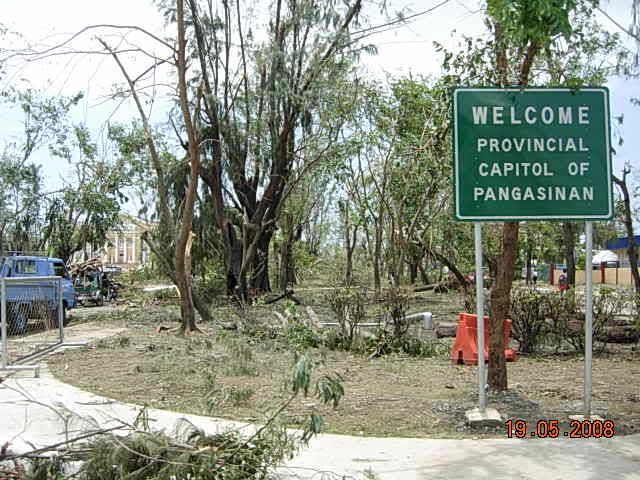
Later on May 17 Halong made landfall on the Philippine region of Pangasinan and traveled towards the northeast over Luzon. Whilst over land Halong weakened in to a tropical storm with both the JTWC and the JMA downgrading Halong early the next day. Later that day after reaching the Philippine Sea, Halong started to re strengthen and intensified in to a severe tropical storm. However it did not intensify any further and on May 19 weakened in to a tropical storm. Later on May 19 PAGASA issued their final advisory on Halong as it moved out of their area of responsibility. The JTWC then issued their last advisory on Halong as it had began its extra tropical transition the JMA then reported that it had completed its extra tropical transition and issued their final advisory on the remnant low of Halong. The remnants of Halong dissipated on May 24.

Preparations

Starting May 15, PAGASA issued Storm Warning Signals for various areas across the Philippines. At 1500 UTC that day Signal Number One was initially issued over northern Palawan, Occidental Mindoro and Lubang Island. At its maximum coverage (at 0930 UTC 17 May), Storm Signal Number 3 was issued for Zambales, Pangasinan, La Union, Tarlac, Benguet and Ilocos Sur, Signal Number 2 was for Bataan, Bulacan, Pampanga, Nueva Viscaya, Nueva Ecija, Quirino, Ifugao, Mt. Province, Kalinga, Abra, Apayao and Ilocos Norte and Signal Number 1 was raised for Lubang Island, Batangas, Cavite, Laguna, Rizal, northern Quezon, Isabela, Aurora, Cagayan, Calayan Island, Babuyan Group of Islands, Batanes and Metro Manila Further on as Cosme (Halong) razed through Northern Luzon, these storm signals were scaled back until the storm reached the Cagayan-Batanes area and the Pacific Ocean proper.

Impact
In Luzon, the Typhoon caused 58 deaths and $94 million (USD) in damage. The storm destroyed 43,365 houses and damaged 188,830 more. Most of the damages reported were in Northern Luzon. Meanwhile, Mindoro and Panay islands were also affected as the storm-induced southwest monsoon brought rains and floods to those areas. In particular, a ferry in Mindoro was stranded as Cosme (still a tropical depression that time) passed close enough to Mindoro Thursday night (May 15). The Subic-Olongapo area, one of the economic zones of the Philippines, experienced power outages as the storm gets closer to Zambales on May 17. The province of Pangasinan, where the storm made its landfall, experienced waist-high floods and power outages as well. Even the city of Dagupan (in Pangasinan) suffered the same fate with even stranded persons all over the city due to flooding. The town of Sta. Cruz in Zambales had about 7,000 people homeless due to Cosme. Overall, the hardest hit were Pangasinan and Zambales provinces. Because the damage caused by the storm in Zambales is extensive even in infrastructure, repair was forced to be done on schools there as that time, classes are to resume in the next few weeks. The storm also increased the prices of vegetables in Metro Manila, as the latter gets most of its vegetables from Northern Luzon.

According to the final report on Cosme (Halong) released by the National Disaster Coordinating Council, 61 were reported killed, 33 wounded and three were left missing. People affected by Cosme numbered 1,496,635 persons in 1,510 barangays in five provinces. Damages to property totaled to PHP 4.712 billion, of PHP 3.721 billion were agricultural losses and PHP 992 million were destructed infrastructure. Pangasinan was the most damaged province as indicated by the report.

Saturday, October 25, 2008

L'art Du Déplacement

Parkour (sometimes abbreviated to PK) or l'art du déplacement (English: the art of movement) is an activity with the aim of moving from one point to another as efficiently and quickly as possible, using principally the abilities of the human body. It is meant to help one overcome obstacles, which can be anything in the surrounding environment—from branches and rocks to rails and concrete walls—and can be practiced in both rural and urban areas. Parkour practitioners are referred to as traceurs, or traceuses for females.

Founded by David Belle in France, parkour focuses on practicing efficient movements to develop one's body and mind to be able to overcome obstacles in an emergency.

Parkour is a physical activity that is difficult to categorize. Often miscategorized as a sport or an extreme sport, parkour has no set of rules, team work, formal hierarchy, or competitiveness. It is an art or discipline that resembles self-defense in the ancient martial arts. According to David Belle, "the physical aspect of parkour is getting over all the obstacles in your path as you would in an emergency. You want to move in such a way, with any movement, as to help you gain the most ground on someone or something, whether escaping from it or chasing toward it." Thus, when faced with a hostile confrontation with a person, one will be able to speak, fight, or flee. As martial arts are a form of training for the fight, parkour is a form of training for the flight. Because of its unique nature, it is often said that parkour is in its own category.

A characteristic of parkour is efficiency. Practitioners move not only as fast as they can, but also in the most direct and efficient way possible; a characteristic that distinguishes it from the similar practice of free running, which places more emphasis on freedom of movement, such as acrobatics. Efficiency also involves avoiding injuries, short and long-term, part of why parkour's unofficial motto is être et durer (to be and to last). Those who are skilled at this activity normally have an extremely keen spatial awareness (a.k.a. air sense).

Traceurs say that parkour also influences one's thought process by enhancing self-confidence and critical-thinking skills that allow one to overcome everyday physical and mental obstacles. A study by Neuropsychiatrie de l'Enfance et de l'Adolescence in France reflects that traceurs seek for more sensation and leadership than gymnastic practitioners.


- Source: Wikipedia - The Free Online Encyclopedia

Brief History of Pangasinan National High School

The name Pangasinan National High School, the Alma Mater of thousands of illustrious men and women, evolved from very colorful educational, political and economic scenarios of the past. Organized in 1908 and supported by the provincial government, it admitted fifth grade to first year students in rented buildings at the heart of Lingayen, the capital town. Being the first provincial school of the biggest province of Luzon, it was initially named Pangasinan High School when increased high school enrollment in the multi-grade classes paved the way to its separation from elementary school in 1920. Then in 1926 through 1927, continuing changes took effect again changing the name to Pangasinan Academic High School for the academically inclined and giving birth to Pangasinan Vocational High School for the vocationally inclined, both as autonomous units.

The recession in 1930 aggravated by frequent typhoons which resulted to poor harvest and consequently lesser enrollments forced the fusion of the Pangasinan Academic High School and the Pangasinan Vocational High School to form the Pangasinan Secondary School, the third name shift in 1935 through 1936.

Forming the first bulk of the teaching force were the recruited Americans from the Occupation Army during the Fil-American War and volunteers who arrived via the USS Thomas. In 1913, thirteen graduates proudly marched in the very first graduation rites.

After the leave of absence in 1938 by Mr. Arthur Allison, the last American principal, (preceded by Messrs. Hare, Heidenrich, Abada, Wullenburg and Blackledge), Mr. Juan C. Manuel followed by Mr. Ricardo Ortega as OIC and Mr. Eufronio Malonzo, 1938 appointed principal, took charge of the school.

In 1940, the Pangasinan Secondary School was reverted into two independent units. Pangasinan High School and the Pangasinan Trade School.

During World War II, Pangasinan High School closed its doors and re-opened in January 1945 and was renamed Pangasinan Provincial High School until 1969 after which became Pangasinan National High School by virtue of a national legislation.

Postwar principal included Messrs. Eduardo Edralin, Angel Fermo and Fermin Montano. Since 1952, women who had been principal were: Miss Carmen dela Cruz (1952-1967); Mrs. Rolendia S. Edralin (1967-1973); Mrs. Adoracion R. Ramos (1974-1984); Miss Beatriz D. Cruz (1984-1988); Mrs. Natividad A. Cruz, OIC (1988-1989); Mrs. Juliana B. Laoag (1989-1995); and Dr. Lolita R. Salomon (1995 to 2004); Mrs. Zenaida T. Cervantes (2004-2006); Dr. Aurora C. Micu (2007 to present).

Thursday, October 9, 2008

Santa Claus, Are You For Reality?


Santa Claus, also known as Saint Nicholas, Father Christmas, Kris Kringle, or simply "Santa", is the ghost of Saint Nicholas who, in Western cultures, is described as bringing gifts on Christmas Eve or Christmas Day, or on his feast day, December 6. The legend may have its basis in hagiographical tales concerning the historical figure of Saint Nicholas.

The modern depiction of Santa Claus as a fat, jolly man (or gnome) wearing a red coat and trousers with white cuffs and collar, and black leather belt and boots, became popular in the United States in the 19th century due to the significant influence of caricaturist and political cartoonist Thomas Nast. This image has been maintained and reinforced through song, radio, television, and films. In the United Kingdom and Europe, his depiction is often identical to the American Santa, but he is commonly called Father Christmas.

One legend associated with Santa says that he lives in the far north, in a land of perpetual snow. The American version of Santa Claus lives at the North Pole, while Father Christmas is said to reside in Lapland. Other details include: that he is married and lives with Mrs. Claus; that he makes a list of children throughout the world, categorizing them according to their behavior; that he delivers presents, including toys, candy, and other presents to all of the good boys and girls in the world, and sometimes coal or sticks to the naughty children, in one night; and that he accomplishes this feat with the aid of magical elves who make the toys, and nine flying reindeer who pull his sleigh.

There has long been opposition to teaching children to believe in Santa Claus. Some Christians say the Santa tradition detracts from the religious origins and purpose of Christmas. Other critics feel that Santa Claus is an elaborate lie, and that it is unethical for parents to teach their children to believe in his existence. Still others oppose Santa Claus as a symbol of the commercialization of the Christmas holiday, or as an intrusion upon their own national traditions.